
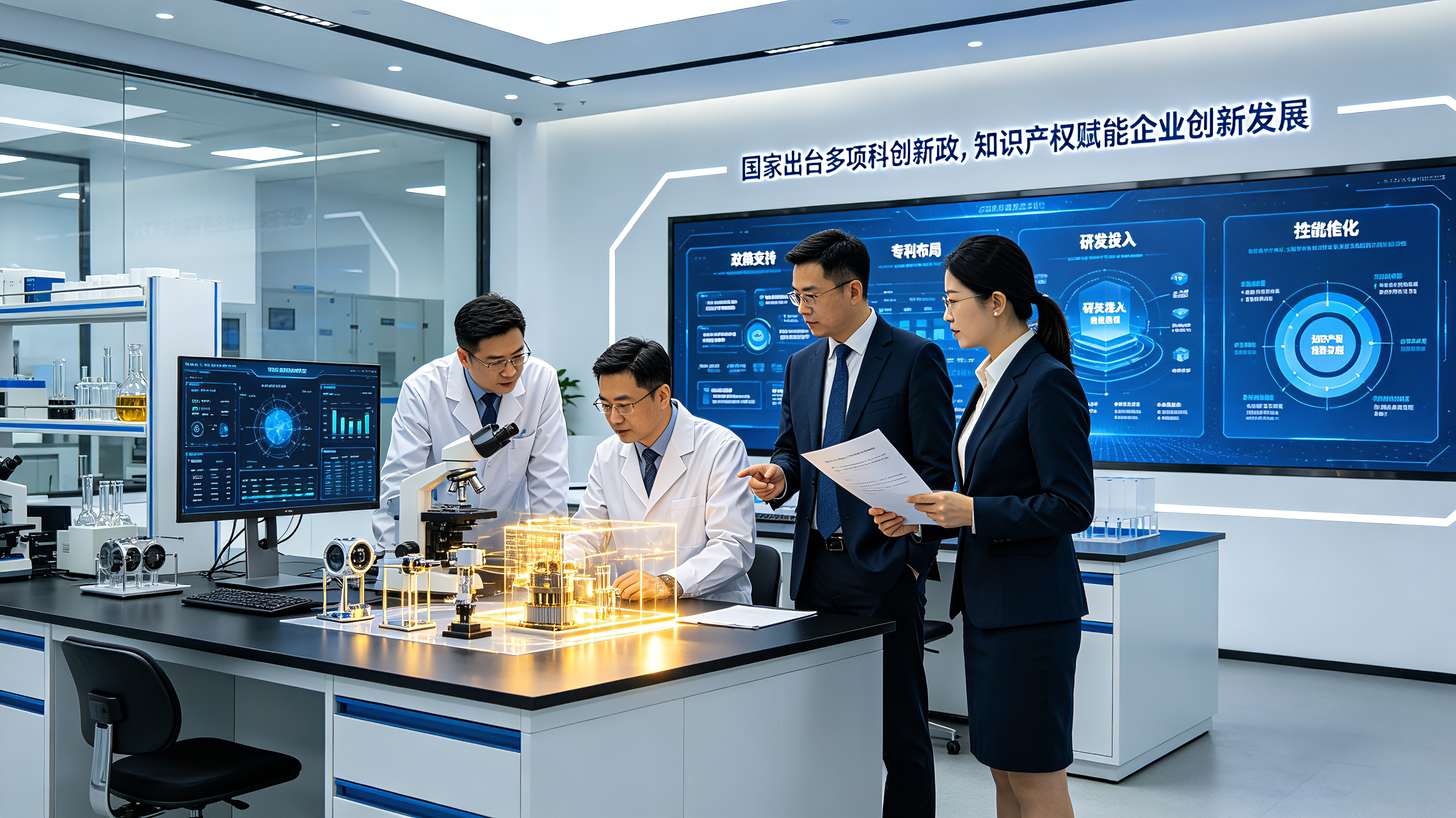
The government has introduced multiple new policies on scientific innovation, empowering enterprises to innovate through intellectual property.
Introduction: From "Protective Shield" to "Growth Engine"
In the past, many companies viewed intellectual property (IP) as a passive defensive tool—simply filing patents to prevent others from copying. However, in the 2026 policy context, IP has been redefined asThe core link between technological achievements and their transformation into real productive forcesandStrategic asset for enterprise innovation and developmentWith the conclusion of the "Special Action Plan for Patent Transformation and Utilization (2023–2025)", the formal issuance of the "15th Five-Year Plan for Intellectual Property Protection and Utilization" (State Council Document [2]2026 No. 30) in 2026 year 7 month, and the implementation of new supporting policies covering artificial intelligence, data intellectual property, and pledge financing, the underlying logic of China's national science and innovation policy has become clear: moving beyond simple encouragement of "patent quantity," the focus is now on institutional supply to drive high-value patents toward industrialization, financialization, and internationalization.
As of the end of 6 in 2026, China's stock of high-value invention patents reached236Knumber of high-value invention patents per 10,000 people16.8 itemsStrategic emerging industry patents account for over 70% of high-value invention patents. The "15th Five-Year Plan" goal has been raised further toMore than 22 cases per 10,000 peopleThis hard metric shifts the yardstick for evaluating corporate innovation from "how many patents were filed" to "how much revenue, debt relief, and order volume a patent generates."
I. Three Core Pillars of New Science & Innovation Policies: Quality, Commercialization, and Finance
1. Patent Quality Orientation: Fiscal Subsidy Declaration System and Mandatory Activation of "Sleeping Patents"
The sharpest blow of the new policy targets "low-quality patents." The Special Action Plan explicitly emphasizes patent-related assessments.Quality and conversion efficiencyFinancial aid and rewards must not be tied simply to the number of patents. For patents granted financial assistance that remain unimplemented for more than 5 years without valid reason, the state may implement them free of charge or license them to others.
implement simultaneouslyDeclaration System for Patents Resulting from Government-Funded Research ProjectsExpand the scope and track conversion benefits to compel research institutions to conduct industrialization feasibility assessments before filing. For enterprises, this means: in future applications for High-Tech Enterprise status, "Specialized and New" designation, "Little Giant" recognition, or technology projects, the weight of patent counts will decrease.Type I Invention Patent, Overseas Family, Maintained for 10+ Years, Recipient of China Patent Award"High-value tags" are the bonus.
2. Commercializing Patents: Establishing a Routine Mechanism to Move from "Bookshelves" to "Store Shelves"
2023—2025 Special Campaign: Results Delivered. Over 2700 universities and research institutions nationwide have inventoried 134.9 million existing patents, identifying 68 million for commercialization and connecting them with 46 enterprises. The industrialization rate of invention patents has risen to 10.1% in universities and 17.2% in research institutions. For enterprises, the industrialization rate of invention patents increased from 44.9% in 2020 to 53.3% in 2024.
The 15th Five-Year Plan institutionalizes this mechanism: implement it in depth.Patent Navigation EngineeringFocus on emerging and future industries; establish industrial intellectual property operation centers, innovation consortia, and key industry patent pools; comprehensively carry outPatent-Intensive Product Filing and CertificationBy the end of 2025, high-tech enterprises and specialized, refined, differential, and innovation (SRDI) enterprises will be fully covered. The value-added output of patent-intensive industries exceeded 18 trillion yuan in 2024, accounting for 13.38% of GDP—this is a policy windfall that businesses can genuinely leverage.
3. IP Finance: Enabling "Asset-Light" Enterprises to Secure "Capital-Heavy" Funding
New policies directly address the long-standing challenge faced by asset-light tech companies: holding patents but lacking collateral.During the 14th Five-Year Plan period, banking and financial institutions issued intellectual property-backed loans exceeding 9000 billion yuan, benefiting over 11 million SMEs.Risk compensation policies have been issued in 13 provinces and 124 cities.
Further upgrades in 2026: Expanded online pilot for pledge registration, initiated internal bank assessment pilots, explored "loan + direct external investment," advanced intellectual property securitization, and implemented data IP pledging (Hubei completed the first case of data IP licensing plus pledge financing totaling 5000 yuan). An Anhui-based quantum technology company secured tens-of-millions in pledge financing backed by over 10 core invention patents. Wuhan Pingshen Dingcheng leveraged a patent portfolio of 81 items valued at 1 billion yuan to unlock financing—demonstrating that intellectual property has truly become a "trusted collateral."
II. Four-Dimensional Enterprise Empowerment: Innovation, Financing, Global Expansion, and Compliance
1. R&D: Patent navigation helps companies avoid pitfalls.
New policies encourage companies to conduct patent navigation before initiating R&D projects. For instance, the Shijiazhuang Biomedical Operation Center provided global alerts for CSPC Group during the drug molecule design phase for new lipid-lowering targets, building a patent portfolio around core innovations. This enabled them to complete preliminary development in just 2 years.Up to 20.2 billion USD in milestone licensing feesAchieve cross-border conversions; the Zhuzhou Beidou industry leverages big data analytics from 49 million global patents to inform investment promotion and address R&D gaps.
For SMEs, this means no more blind spending on trial and error. Use patent big data to first identify who's doing what, where they stand, and where the gaps are—then direct R&D funds precisely where they matter most.
2. Funding: From "Inspecting Factories" to "Reviewing Claims"
The combined use of intellectual property pledge financing, data IP capitalization on balance sheets, and patent insurance has made "intangible assets" liquid for the first time. For chip, biopharma, and industrial software companies—whose core assets are patent portfolios—the new policy's whitelist notifications and risk compensation mechanisms have enabled banks to lend confidently and businesses to access funding.
3. Going Global: Family Layout and Standard Essential Patents (SEPs)
The 15th Five-Year Plan explicitly calls for improving the special database of standards-essential patents and promoting the integration of patents with international standard-setting. A certain eVTOL enterprise in Sichuan secured hundreds of domestic and international orders by leveraging over 400 patents, validating the logic of "securing rights before going global." The three international channels—PCT applications, Madrid trademarks, and Hague designs—are continuously expanding. In 5 months of 2026 years ago, China's exports of intellectual property licensing fees reached 455 billion yuan, a year-on-year increase of 64.9%.
4. Compliance: Fast Pre-screening and Rights Protection Center Downshift
Nationwide deployment complete83 National Intellectual Property Protection Centers + 54 Rapid Rights Protection CentersCovers all strategic emerging industries. Enterprises enjoy one-stop services for fast pre-examination (reducing the invention patent examination cycle from 15 months), rapid rights confirmation, and rapid enforcement, compressing infringement response timelines from years to months.
3. Sector-Specific Tailwinds: Which Companies Benefit Most from Policy
Specialized and New / "Little Giant"Can be stacked with "One Month, One Chain" roadshows, regional equity market listings, and specialized intellectual property services for IPOs. Patent portfolio quality directly determines subsidy amounts.
Enterprises with Patent-Intensive Products(Advanced Equipment, New Materials, Biomedicine): After passing the filing assessment, enjoy tax incentives, preferential treatment in government procurement, and rights to use patent product labels.
AI/Data Element EnterprisesGuidelines on patentability of AI-generated content and data intellectual property registration certificates have been used in judicial rulings and asset valuation, collectively enhancing financing by nearly 160 billion yuan.
Green Technology EnterpriseOpen implementation of international green technology intellectual property, zero-carbon patent pools, and green factory patent portfolios are all key priorities for the 15th Five-Year Plan.
4. Enterprise Implementation Action Plan (Second Half of 2026 – 2027)
Take stock of your assets: Re-screen our own patents using the "High-Value Five Criteria" (Strategic Emerging Industries, Overseas Family Members, Maintained for 10+ Years, Award-Winning, Invention Patents) and eliminate defensive "junk" patents with no implementation plans.
NavigateConduct patent navigation analysis (via procurement or in-house development) prior to project initiation for new R&D, and deliver three key tables: "Technology Gaps," "Design-Around Strategies," and "Country-Specific Patent Layout."
PledgeSelect 10 to 20 core invention patents for valuation, join the local IP pledge whitelist, and proactively negotiate an "internal valuation" model with partner banks.
Submit for filingHigh-tech Enterprises and "Specialized, Refined, Differential, and Innovative" (SRDI) Enterprises must complete this.Patent-intensive Product FilingThis is the baseline requirement for securing subsequent industrial funding.
Establish policiesEmbed IP management into the entire R&D lifecycle—from project initiation and completion to procurement and offboarding audits—aligned with the ISO standard for "IP Management in Innovation Processes."
Watch the 15th Five-Year PlanLocal supporting measures (e.g., patent navigation subsidies, pledge interest discounts, and data intellectual property registration incentives) will roll out intensively between 2026Q4 and 2027Q2. Local Industry & Information Technology or Intellectual Property officers must track progress monthly.
Conclusion: The window of opportunity for IP dividends has opened.
The direction of the new national science and technology innovation policies is very clear—Empower high-value patents that convert, secure funding, and go global to capture the maximum regulatory benefits; let patents that merely inflate numbers, gather dust in archives, or lack implementation gradually lose policy support.For entrepreneurs, the IP department should no longer be a back-office function limited to "filing patents with stamps," but must evolve into a front-line engine driving "patent asset management, R&D intelligence, and financing credibility enhancement."
In the opening year of the 15th Five-Year Plan, whoever can first turn patents into products, loans, and overseas orders will secure their place in the next round of industrial division.
Note: The policy basis for this article is based on State Council Document [Year 2026] No. 30 "15th Five-Year Plan for Intellectual Property Protection and Utilization," the "Special Action Plan for Patent Transformation and Utilization (Years 2023–2025)," and the statements made at the National Press Office's "15th Five-Year" Intellectual Property Press Conference held on 2026/7/30.