
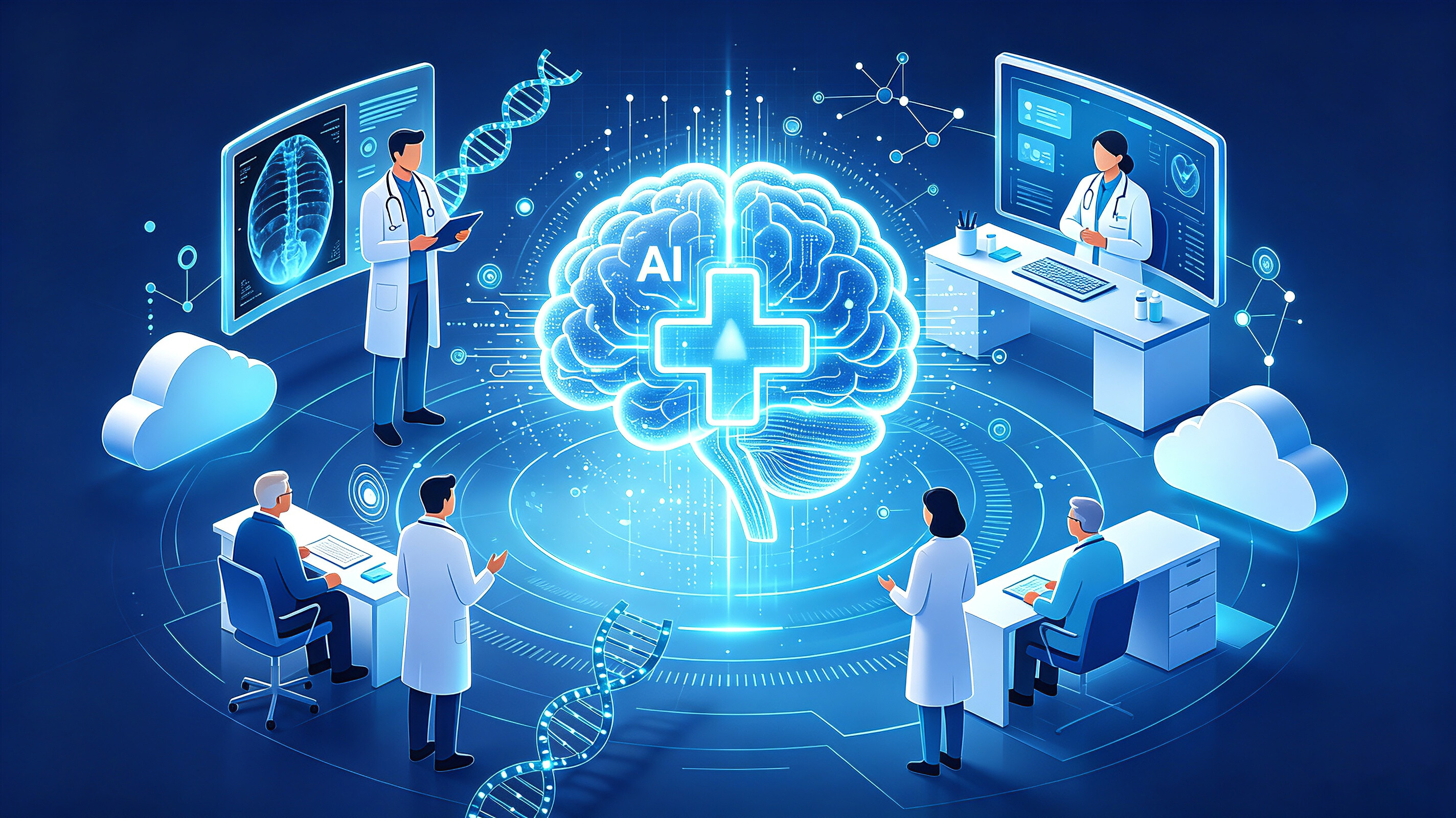
Deep iteration of AI is driving a disruptive transformation across global healthcare. From precision imaging and efficient drug development to expanding access in primary care and intelligent chronic disease management, medical AI is breaking down long-standing industry barriers—low efficiency, resource inequality, and limited accuracy—serving as the core engine for digitizing and intelligently upgrading healthcare systems. Today, medical AI has moved from conceptual exploration to large-scale deployment, yet it still faces significant challenges including technical bottlenecks, data silos, and regulatory gaps. Only through collaborative efforts and sustained breakthroughs in technology, application scenarios, and operational mechanisms can smart healthcare take root, benefit billions of people, and advance the high-quality development of China's Healthy China initiative.
Scaling medical AI in clinical settings has driven significant breakthroughs, reshaping traditional healthcare delivery. In radiology, AI effectively addresses human limitations and serves as a powerful assistant to physicians. Traditional image interpretation relies heavily on experience, is time-consuming, and prone to missed diagnoses. In contrast, AI-powered imaging systems rapidly scan full layers, precisely marking lesion location, size, and risk levels—particularly excelling at detecting micro-nodules and occult abnormalities. Clinical data shows that hospitals using AI-assisted systems have reduced lung nodule miss rates by approximately 18% and boosted basic reading efficiency by 40%, significantly shortening patient wait times. Beyond routine chest X-rays, "AI + Vascular CTA" technology is now successfully deployed for diagnosing critical cardiac, pulmonary artery, and major vessel emergencies, enabling rapid detection of life-threatening conditions like pulmonary embolism and vascular occlusion. This accelerates emergency response, securing the golden window for treatment and markedly improving survival rates for critically ill patients. In pathology, large-scale medical models achieve high-precision karyotype analysis with segmentation accuracy reaching 99.86%, providing reliable evidence for genetic disease and tumor diagnosis while addressing longstanding gaps in traditional pathology testing.
In drug discovery and scientific innovation, AI is breaking through traditional limitations to reshape the pharmaceutical R&D value chain. Historically, new drug development has been characterized by a "10 years, $1 billion" model: spanning target identification, molecular design, and clinical trials, it typically takes over a decade and costs more than $10 billion, with an extremely high failure rate. The integration of AI has fundamentally transformed this landscape. Leveraging deep learning, big data simulation, and intelligent reasoning, AI can rapidly screen drug targets, optimize molecular structures, and simulate clinical trials—significantly compressing development timelines and reducing costs. In medical research, AI agents demonstrate exceptional power in accelerating scientific breakthroughs. Hypotheses that once required researchers to spend a decade conducting extensive wet-lab experiments can now be simulated and validated by AI systems in a fraction of the time. This dramatically accelerates progress in basic medical research, pathogen studies, and resistance mechanism analysis, offering fresh perspectives for tackling complex diseases and developing novel therapeutics, and driving transformative leaps in medical science.
Inclusive primary care is the core value of medical AI breakthroughs, effectively addressing the critical social challenge of uneven healthcare resource distribution. For years, high-quality medical resources have been concentrated in major cities and top-tier tertiary hospitals, leaving grassroots facilities with limited diagnostic capabilities and causing significant difficulties for patients seeking care due to distance and accessibility. The deployment of medical AI at the grassroots level breaks down barriers related to geography, equipment, and talent, enabling comprehensive access to premium medical services. Powered by cloud-based large medical models, primary care facilities no longer need expensive on-premise computing infrastructure; they can leverage top-tier hospital AI diagnostic capabilities using only basic digital devices, reducing network bandwidth requirements by 85% and significantly lowering the cost of intelligent transformation. Currently, intelligent screening AI systems are widely deployed across county-level medical consortia and township health centers, providing residents with access to tertiary hospital-grade precise screening for common conditions such as pulmonary nodules, strokes, tuberculosis, and retinal diseases—all within their local communities. This advancement effectively promotes the implementation of tiered diagnosis and treatment systems and drives the equitable distribution of healthcare resources.
Meanwhile, medical AI continues to breakthrough in chronic disease management, intelligent triage, and personalized treatment, building a comprehensive health service system. Medical agents with long-term memory and cross-system collaboration capabilities integrate patients' full-lifecycle diagnostic data, map out medical histories, precisely monitor chronic patients' health metrics, and predict condition changes—boosting follow-up efficiency for chronic diseases by over 40%. In internet hospital settings, AI-powered triage systems provide 24-hour uninterrupted responses, rapidly routing patients and answering basic inquiries to alleviate outpatient pressure and enhance service accessibility. Leveraging big data analytics, AI also tailors personalized treatment, rehabilitation, and medication plans based on patients' constitution, conditions, and medical histories, driving the shift from "standardized care" to "precision medicine" and significantly improving clinical outcomes.
Addressing development gaps and tackling core challenges are essential prerequisites for sustained breakthroughs in medical AI. Currently, the industry faces several bottlenecks: **Technology:** Some AI models lack sufficient generalization capabilities, with limited accuracy in identifying complex or rare cases, making it difficult to fully adapt to diverse clinical scenarios. **Data:** Medical data remains fragmented across institutions, hindered by inconsistent standards, poor interoperability, and significant risks to data security and privacy. **Industry:** Regulatory frameworks for product approval and clinical application guidelines remain incomplete. Many products struggle with real-world deployment, reflecting a common imbalance between R&D investment and practical implementation. **Talent:** There is a critical shortage of professionals with dual expertise in medicine and artificial intelligence, constraining both technological advancement and scene-specific adoption.
Advancing medical AI requires building a comprehensive development system centered on "technological innovation, data empowerment, regulatory guidance, and ecosystem collaboration." First, deepen core technology R&D by focusing on key areas such as medical large models, intelligent algorithms, and medical robots. Increase research investment to overcome critical challenges in high-precision recognition, complex scenario adaptation, and multimodal data fusion. This will enhance the accuracy, stability, and generalizability of AI-driven diagnosis and treatment while strengthening autonomous and controllable capabilities at the foundational level. Second, improve the medical data governance framework by standardizing data collection, storage, and sharing across the industry. Establish a secure and compliant medical data sharing platform that unlocks the value of medical data resources for AI model iteration, all while strictly protecting patient privacy and ensuring data security.
Furthermore, strengthen industry standards and regulatory frameworks by accelerating the refinement of registration approval, clinical application, and quality assessment criteria for medical AI products. Clearly define rights and responsibilities in AI-assisted diagnosis and treatment, regulate market order, prevent misuse of technology, and ensure safe, compliant, and orderly development of medical AI. Simultaneously, deepen collaboration among academia, industry, research institutions, and healthcare providers to build joint innovation platforms. Oriented talent development programs should cultivate interdisciplinary medical AI professionals, aligning R&D with clinical needs to accelerate the translation of research outcomes into tangible clinical benefits. Finally, continue promoting the widespread adoption of medical AI at the grassroots level by optimizing intelligent healthcare solutions for primary care facilities, reducing implementation costs, and expanding access to smart diagnostic services—ensuring that rural communities and underserved populations can equally benefit from advancements in intelligent healthcare.
Technology for Good, Medicine for the Future. Breakthroughs and innovations in medical AI represent an inevitable trend where the digital economy and public health converge deeply, serving as a vital tool to safeguard citizens' well-being and advance China's Healthy Nation initiative. From assisting diagnosis to driving research innovation, from elite care to accessible healthcare, medical AI is reshaping the service ecosystem with technological power to solve longstanding pain points in traditional medicine. In the future, only by deepening technical expertise, addressing gaps, optimizing the ecosystem, and staying true to medical ethics can we achieve continuous breakthroughs in technology, applications, and value. This will empower high-quality development of the healthcare sector through artificial intelligence, ensuring that more accessible, efficient, and inclusive medical services reach everyone, building a solid technological foundation for national health.