
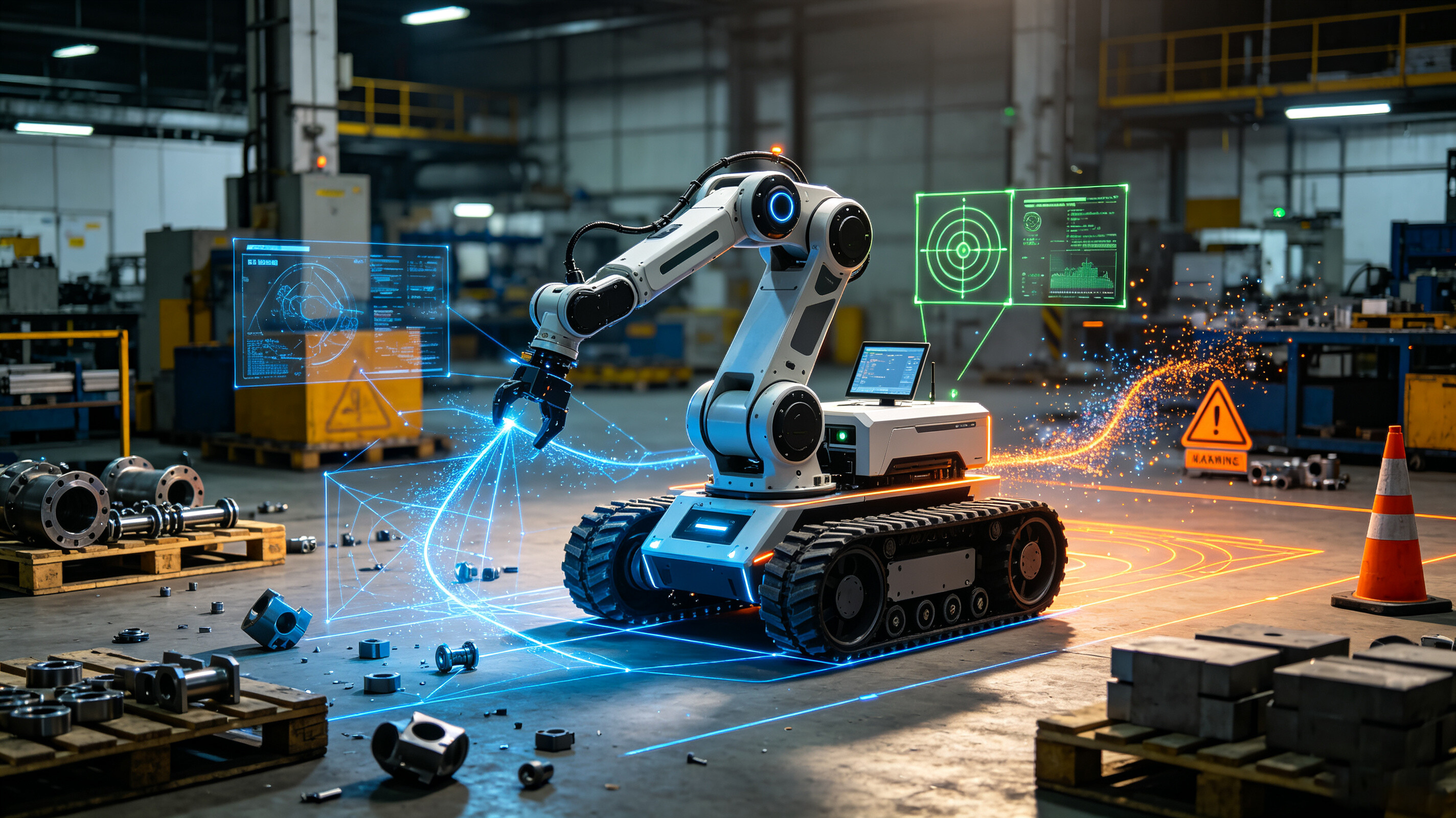
Embodied AI breaks the barrier that confines traditional artificial intelligence to digital computation, enabling robots to achieve deep interaction with the real physical world. Unlike industrial robots that repeat fixed instructions in predefined environments, task-oriented robots for unstructured settings rely on multimodal perception to understand complex real-world scenarios. They autonomously perform judgment, decision-making, and action execution, marking a key direction in robotics development. In dynamic, complex environments such as warehousing and logistics, emergency response, outdoor inspection, and home services—where layouts are disordered, object shapes vary, and external disturbances abound—traditional pre-programmed robots often fall short. Adaptive robots powered by multimodal perception offer a solution to these challenges in unstructured environments.
Multimodal perception is the foundation for robots to interact with the physical world. By fusing data from cameras, depth sensors, LiDAR, force/tactile sensors, and microphones, robots simultaneously capture visual, distance, force, and audio information. Single sensors have clear limitations: vision is affected by lighting changes and occlusions; LiDAR struggles with transparent objects; force sensors excel at detecting subtle contact forces. Multimodal perception uses fusion algorithms to calibrate, complete, and denoise data from diverse sources, building a comprehensive digital model of the environment. This enables robots to see, hear, and feel their surroundings, accurately identifying unknown objects, obstacles, and dynamic terrain to understand unstructured environments.
The core challenge of unstructured environments lies in their inherent uncertainty. In structured factory settings, locations, objects, and workflows are predefined, allowing robots to operate along fixed trajectories. However, most real-world scenarios lack standardized layouts: rescue sites feature randomly piled debris; outdoor operations face sudden lighting changes and weather interference like rain or snow; and target objects vary unpredictably in size, material, and orientation. Consequently, robots cannot rely on pre-loaded maps or templates. They must possess real-time adaptive capabilities. Leveraging large models and embodied AI algorithms, robots dynamically adjust their motion paths, grasp poses, and applied force based on real-time environmental data from multimodal sensing. They autonomously navigate around obstacles, determine grasp points for unknown objects, and modulate grip strength via haptic feedback upon contact—preventing crushing or slippage—to enable fully autonomous operation without human teleoperation.
From a technical standpoint, embodied intelligence closes the loop across "perception, understanding, decision-making, execution, and feedback." Robots collect physical-world data via multimodal sensors, feed it into models for scene understanding, and generate motion control commands based on task objectives to drive manipulators and mobile bases. During operation, continuous contact feedback is captured and fed back to the algorithm to refine subsequent actions in real time, creating an iterative closed loop. This loop is key to enabling robots to adapt to dynamic, unstructured environments—transforming them from mere code executors into agents capable of trial-and-error learning, adjustment, and successful completion of complex physical tasks.
This technology still faces significant real-world challenges. Multimodal sensor data is voluminous, and information fusion demands high computational power; in complex environments, perception noise can lead to misinterpretation; and the physical execution precision and compliance control capabilities of robots require further improvement. Looking ahead, as embodied large models evolve and sensors become smaller and more cost-effective, multimodal adaptive-perception robots will see broader adoption. These systems will break through the limitations of traditional robots, delivering value in disaster relief, smart manufacturing, and public services. They will enable AI to transition from the virtual digital realm into the intricate physical world—marking a leap from "seeing and thinking" to "taking action."